2025
Authors:
Hadjikakou, M., Bowles, N., Geyik, O., Conijn, S., Mogollon, J., Bodirsky, B., Muller, A., Weindl, I., Moallemi, E., Shaikh, M. A., Damerau, K., Davis, K. F., Pfister, S., Springmann, M., Clark, M., Metson, G. S., Röös, E., Bajzelj, B., Graham, N. T., & Bryan, B. A.
Abstract:
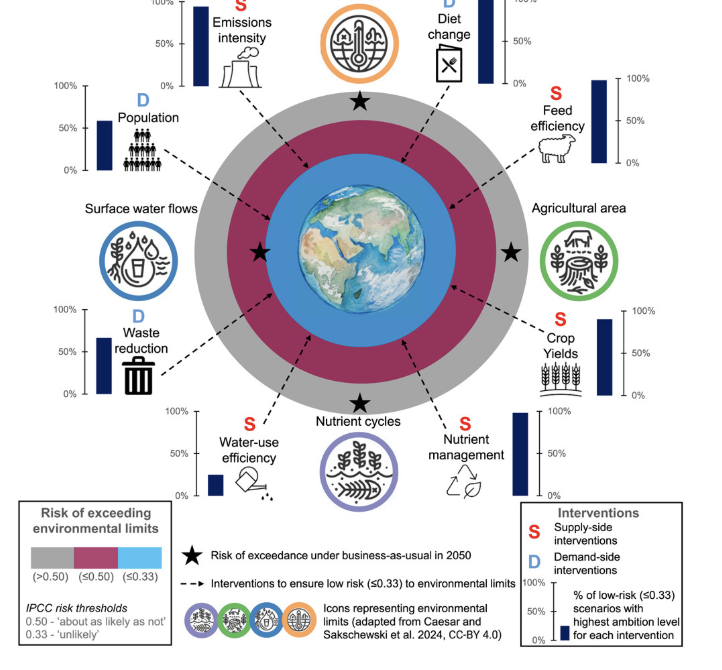
The global food system is a leading driver of environmental change, and current trajectories of food production and consumption risk breaching planetary boundaries. While previous studies have assessed the efficacy of behavioral and technological interventions using a range of food system models, no systematic analysis has controlled for differences in methods and model assumptions, limiting the comparability and actionability of findings. We developed a risk assessment framework, underpinned by an evidence synthesis of global food system modelling studies, to quantify the potential of individual and combined interventions to mitigate the risk of exceeding four key environmental limits, agricultural area, greenhouse gas (GHG) emissions, surface water flows, and nutrient cycles, by 2050. We found that only a small number of intervention combinations are compatible with all four environmental limits simultaneously. GHG emissions and nutrient cycles are the most difficult limits to avoid breaching, and doing so is conditional on dietary shifts away from animal-source foods, steep reductions in emissions intensity, substantial improvements in nutrient management and feed-conversion ratios, increased crop yields, and reduced overconsumption and food waste. Diet change, GHG intensity, nutrient management, and feed efficiency emerge as the critical intervention levers. Ambitious, coordinated policy action across the global food system is essential to enable the required intervention combinations, and feasibility assessments across diverse geographic and socioeconomic contexts should be treated as a research priority.