2025
Authors:
Pathirana, N. L., Sun, Y.-Y., Li, M., Wakiyama, T., Faturay, F., Singh, S., Stevens, M. C., Raubenheimer, D., & Lenzen, M.
Abstract:
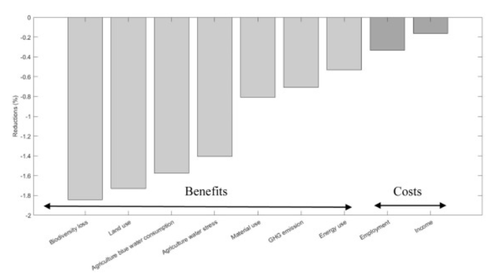
This study found that replacing livestock meat with soy-based alternatives could reduce biodiversity loss, land use, and agricultural water consumption, while causing only modest socio-economic impacts. Plant-based meat substitutes are becoming increasingly popular as an alternate protein source. We used input-output analysis to model the environmental and socio-economic impacts of transitioning to soy-based meat substitutes to replace macronutrients lost from reductions in livestock meat consumption. We found that soy-based meat substitutes can be macronutrient replacements for livestock meat with significant environmental benefits mostly in reduced biodiversity loss, land use, and agricultural water consumption. We also found that expansions of soybean cultivation are not necessary for the transition as the decrease in soybeans for animal feed is more than sufficient to meet the increase in soybeans for soy-based meat substitutes. There are small decreases in employment and income in the livestock sector from the transition, but negative socio-economic impacts are less substantial compared to the environmental benefits. Therefore, transitioning to soy-based meat substitutes could mitigate adverse environmental impacts and improve the sustainability of global food systems.