2025
Authors:
Moallemi, E. A., Castonguay, A. C., Mason-D’Croz, D., Nelson, R., Britz, W., Allen, C., Hadjikakou, M., Battaglia, M., Bryan, B. A., Conti, C., Marcos-Martinez, R., Frank, S., Nong, D., Eker, S., Razavi, S., Navarro-Garcia, J., & Gao, L.
Abstract:
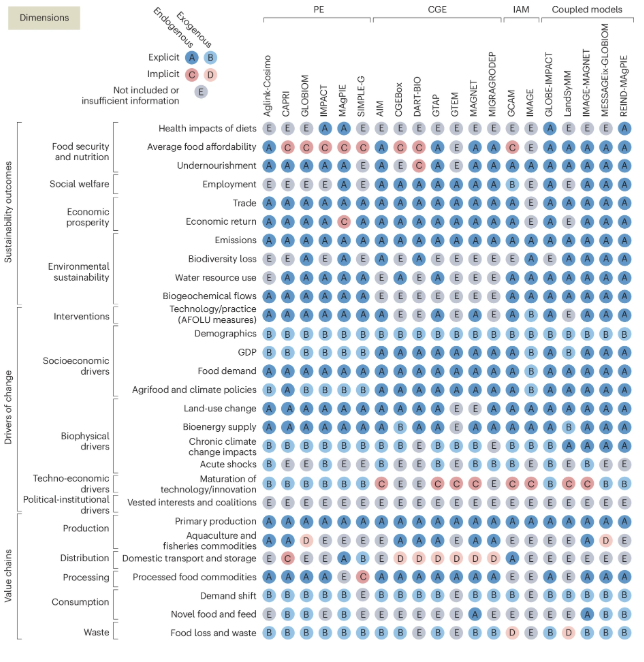
Food systems face multidimensional pressures and require integrated assessments across environmental, social, health and economic dimensions. This paper evaluates the ability of current models to represent food systems and identifies challenges around socio-political dynamics, human–nature feedbacks, global–local links and robustness under uncertainty. It concludes that more diverse and inclusive participatory processes are needed to better support decision-making. Food systems face multi-dimensional pressures and require integrated assessments of environmental, social, health and economic dimensions to inform their transformation. Although economic equilibrium models and integrated assessment models have been instrumental in this context, future decision-making requires more diverse and inclusive participatory processes. Here we evaluate the ability of current models to represent food systems and identify challenges and opportunities regarding key aspects of their transformative change, including socio-political dynamics and human–nature feedbacks, links between global and local scales, robustness under uncertainty, as well as evolving stakeholder demands. Our analysis underscores the need to rethink how models are designed and used for a more effective integration into decision-making processes.