2025
Authors:
Yang, J., Gao, L., Guo, Z., Dong, Y., Moallemi, E. A., Eker, S., Liu, Q., Chi, Z., Liu, F., Obersteiner, M., & Bryan, B. A.
Abstract:
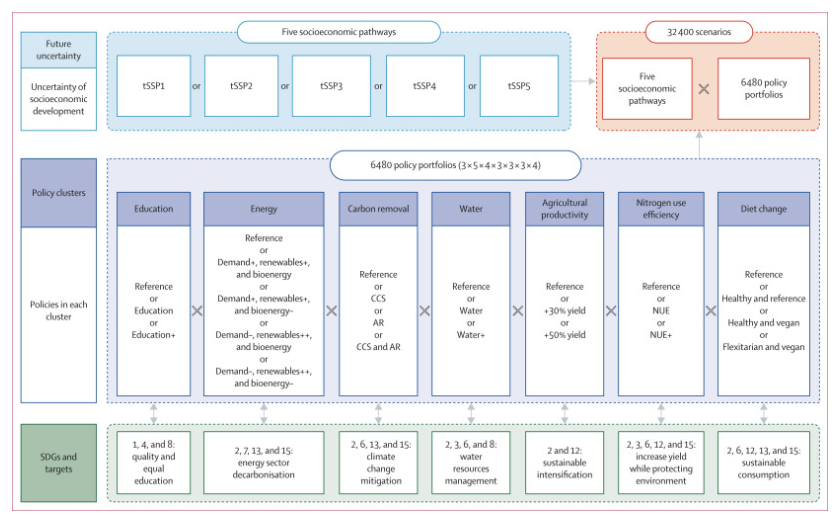
Global progress towards the UN’s Sustainable Development Goals is critically off track. Using an integrated nexus model and a system dynamics approach spanning 12 sectoral modules, this study assessed 6,480 policy portfolios against 32 SDG indicators across ten SDGs to 2050. It found that multisectoral portfolios consistently outperformed single-sector approaches and could improve overall SDG progress by 19.6–29.5% by 2050. Global progress towards the UN's 17 SDGs is critically off track, and comprehensive assessment of how policy interventions interact across goals remains limited. Using the functional enviro-economic linkages integrated nexus model, a system dynamics model spanning 12 sectoral modules, we assessed 6,480 policy portfolios against 32 SDG indicators across ten SDGs to 2050, identifying robust portfolios that accelerate simultaneous SDG progress across five socioeconomic pathways. Multisectoral portfolios consistently outperformed single-sector approaches, with two robust combinations spanning education, energy decarbonisation, crop yields, water use, nitrogen efficiency, dietary change, and climate mitigation, achieving 19.6–29.5% improvement in overall SDG progress by 2050 relative to a no-policy reference. Policy portfolio design mattered more than broader socioeconomic pathways. Accelerating SDG progress requires ambitious, integrated, multisectoral implementation, and the identified portfolios offer concrete, uncertainty-resilient directions for coordinated global action.