2026
Authors:
Wang, X., Geng, X., Sun, F., Han, M., Chen, F., Chen, S., Peñuelas, J., Gao, L., Bryan, B. A., Li, C., Stringer, L. C., Ye, J., Chen, S., Sun, J., Lu, H., Che, H., Liu, H., Liu, B., Dong, Z., Cao, S., Hua, T., Gao, X., Wang, X., Wang, Z., Cai, D., Xu, D., Zhu, W., Lan, Z., Liu, W., Cheng, H., Hu, S., Chen, M., Li, J., Li, D., Liu, F., Zhang, S., Gong, Y., & Dong, Z.
Abstract:
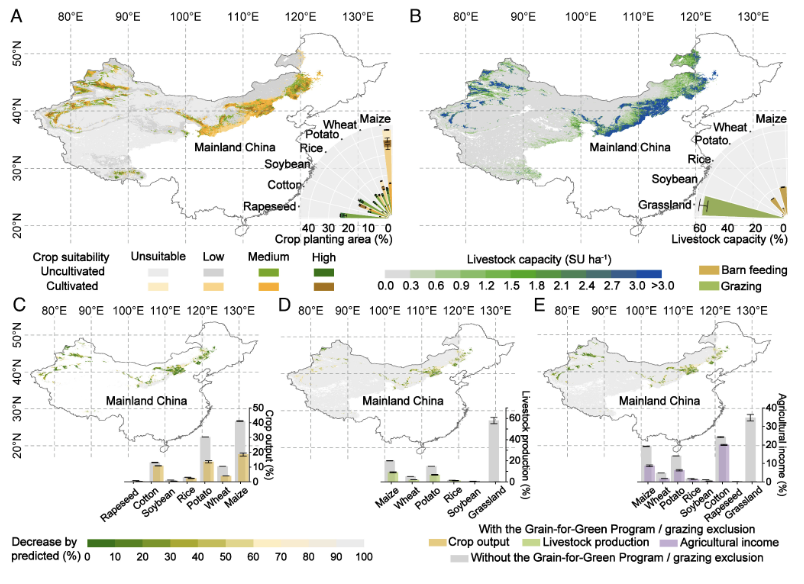
Desertification threatens 24% of global land area across 126 countries, yet mainstream reversal strategies often create hidden risks for long-term sustainable development. This study evaluated the socioeconomic trade-offs of China’s desertification reversal strategies and explored alternative agricultural pathways under projected climate trends. It found that pasture cultivation and crop switching could reduce expenditures while restoring ecosystems, improving productivity and incomes, and conserving water. Desertification threatens 24% of global land area across 126 countries, yet mainstream reversal strategies prioritise short-term vegetation greening over resource constraints and local livelihoods, creating hidden risks for long-term SDG attainment. Using high-resolution crop and pasture suitability models, we evaluated the socioeconomic trade-offs of China's desertification reversal strategies and explored innovative agricultural alternatives under projected 2023–2050 warming and wetting trends. Continuing the Grain-for-Green Program and grazing exclusion would reduce grain output by 54–55%, livestock production by 81%, and agricultural income by 61% compared to a no-intervention baseline. By contrast, strategies emphasising pasture cultivation and crop switching could reduce national desertification expenditures while restoring ecosystems, enhancing agricultural productivity and incomes, and conserving water — contributing 0.7%, 9.8%, and 3.8% toward global progress on SDG 1, SDG 2, and SDG 6 respectively, with trade-offs across other SDGs. These findings offer a reimagined strategic framework for combating desertification and promoting sustainable development in vulnerable arid regions worldwide.