2026
Authors:
Khan, M. S., Moallemi, E., Nazari, A., Thiruvady, D., Marcos-Martinez, R., van Schoten, N., & Bryan, B. A.
Abstract:
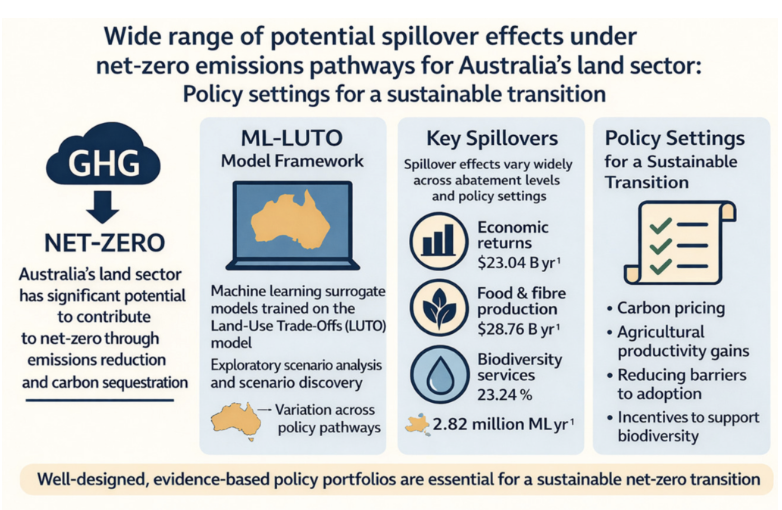
Australia’s land sector can contribute significantly to net-zero emissions goals, but these changes can create major spillover effects across environmental and socio-economic indicators. Using scenario analysis, scenario discovery and machine learning-based surrogate models, this study identified net-zero compliant pathways and quantified their trade-offs and co-benefits. It found that well-designed policy settings could substantially improve economic returns, food and fibre production and biodiversity services, while highlighting the importance of coordinated policy design. The land sector can contribute significantly to net-zero GHG commitments through changes in land-use and management, but these changes can have wide-ranging spillover effects across socio-economic and environmental indicators. Using exploratory scenario analysis, scenario discovery, and machine learning-based surrogate models trained on the Land-Use Trade-Offs (LUTO) model, we identified net-zero compliant pathways at three levels of land sector emissions abatement (low, medium, high) and quantified their spillover effects. We found that substantial land-use change may be required, with both trade-offs and co-benefits for economic returns, food production, biodiversity, and water resources. Spillover effects varied widely with both abatement level and policy settings. Compared to the worst-performing medium abatement pathway, the best-performing pathway achieved $23.04B yr⁻¹ more in economic returns, $28.76B yr⁻¹ more in food/fibre production, and 23.24% greater biodiversity services, at a trade-off of 2.82 million ML yr⁻¹ additional water use. Policy settings driving these outcomes include carbon pricing, agricultural productivity gains, reduced adoption barriers, and biodiversity incentives. The findings underscore the importance of a portfolio of well-designed, evidence-based policy interventions for a sustainable net-zero land sector transition.